
Explore a fully funded UK PhD opportunity in bilingualism, cognitive neuroscience, social communication, and healthy aging.
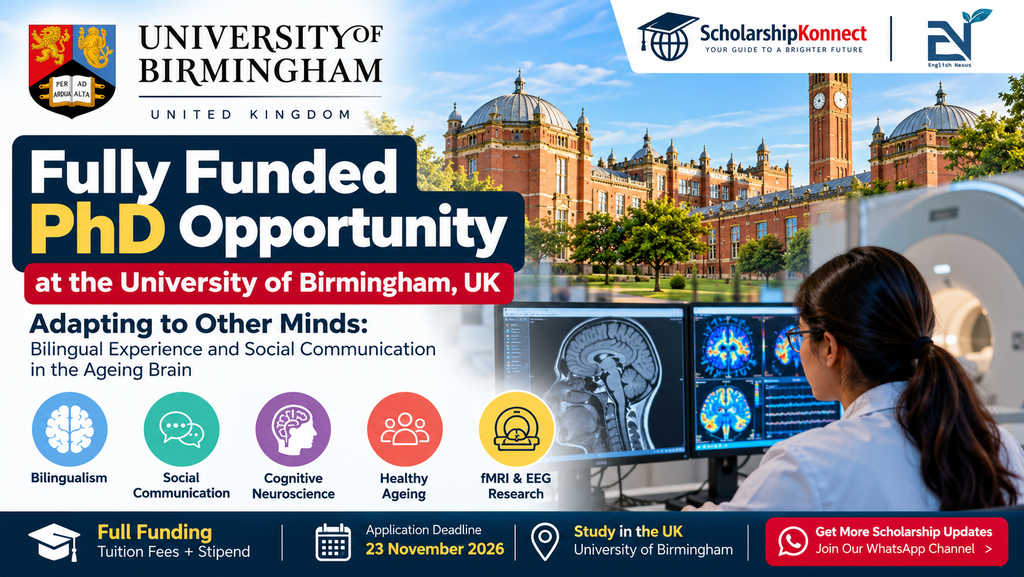
Are you looking for a fully funded PhD in the UK for 2026–2027? The University of Birmingham is advertising an exciting doctoral research opportunity for candidates interested in bilingualism, the aging brain, psycholinguistics and social cognition.
The project, titled “Adapting to Other Minds: Bilingual Experience and Social Communication in the Ageing Brain,” will investigate how lifelong bilingual experience influences the brain mechanisms responsible for understanding language and communicating effectively with others in older adulthood.The studentship is advertised through the Midlands Integrative Biosciences Training Partnership (MIBTP) and offers funding covering tuition fees and a stipend, alongside specialist research training. For students aspiring to pursue a research career in neuroscience, psychology, linguistics or interdisciplinary language studies, this opportunity may be worth exploring.
PhD Opportunity at a Glance
| Detail | Information |
|---|---|
| University | University of Birmingham, United Kingdom |
| PhD project | Adapting to Other Minds: Bilingual Experience and Social Communication in the Ageing Brain |
| Research areas | Bilingualism, cognitive neuroscience, psycholinguistics, social cognition and aging |
| Funding | Advertised as fully funded, including fees and a stipend |
| Research methods | Functional magnetic resonance imaging (fMRI) and electroencephalography (EEG) |
| Training partnership | Midlands Integrative Biosciences Training Partnership (MIBTP) |
| Supervisors | Professor Andrea Krott and Professor Tamara Swaab |
| Application deadline | 23 November 2026 |
| Study destination | Birmingham, United Kingdom |
Important: Applicants should consult the official project and funding pages to confirm eligibility requirements, the precise funding conditions, stipend amount, fee coverage, and application procedure.
1. About the Fully Funded PhD Project
The PhD project examines the relationship between bilingual experience and the cognitive and neural processes involved in social communication. Bilingualism is not simply the ability to speak two languages. Using multiple languages throughout life may involve navigating different linguistic contexts, interpreting other people’s intentions and adapting communication to different social situations. The researchers aim to investigate whether and how these lifelong experiences relate to the brain systems that support social cognition and successful language comprehension in older adults. The project brings together language research, neuroscience and aging studies to explore questions about how people understand one another and how the brain processes socially guided communication. For prospective doctoral researchers, this interdisciplinary approach offers an opportunity to investigate language not only as a linguistic system but also as a cognitive and social process.
2. What Will the PhD Research Investigate?
The project focuses on several interconnected research areas.
Bilingualism and the aging brain
The research will examine how lifelong bilingual experience relates to brain function in older adulthood. It offers a framework for investigating the relationship between language experience, cognitive processes and aging. Applicants should note that the project investigates these relationships; it should not be interpreted as proof that bilingualism necessarily prevents cognitive decline or protects against dementia.
Social cognition and communication
Social cognition involves the mental processes people use to understand others, interpret social situations and respond appropriately.
Communication frequently requires more than recognising words. People also use context and social information to interpret meaning. The project aims to investigate the brain networks supporting these processes in older adults.
Language comprehension
The research will also examine how people comprehend language when social information influences interpretation. This is particularly relevant to psycholinguistics and cognitive neuroscience because it connects language processing with the social contexts in which communication takes place.
Neural mechanisms and cognitive processing
The project will investigate both the brain networks associated with social cognition and communication and the timing of processes involved in socially guided language comprehension.
Together, these research questions create an interdisciplinary investigation of bilingual experience, social interaction and cognitive functioning in later life.
3. Research Methods: fMRI and EEG
A major feature of this PhD opportunity is its use of neuroimaging and electrophysiological methods.
Functional magnetic resonance imaging (fMRI) measures changes associated with brain activity and can help researchers identify brain regions and networks involved in particular cognitive tasks.
Electroencephalography (EEG) records electrical activity at the scalp and allows researchers to investigate the timing of cognitive processes during language comprehension and other tasks.
Using these methods together can provide complementary insights into where relevant brain activity occurs and how cognitive processes unfold over time.
The project also offers the possibility of developing specialist skills in cognitive neuroscience, psycholinguistics, neuroimaging and aging research.
Applicants should review the official project description to determine the expected methodological background and the extent of training provided.
4. Who Should Apply for This PhD in the UK?
This opportunity may appeal to applicants with academic interests in:
- Cognitive neuroscience and brain research.
- Psychology and cognitive psychology.
- Psycholinguistics and language processing.
- Bilingualism and multilingual language use.
- Social cognition and human communication.
- Aging research and cognitive functioning.
- Interdisciplinary research connecting language, cognition and neuroscience.
However, a relevant academic interest does not automatically establish eligibility. The formal entry requirements, accepted qualifications, academic background requirements and any language proficiency requirements must be checked on the official application pages.
Students from linguistics or language-related backgrounds should pay particular attention to whether their qualifications and research experience meet the project’s specific requirements.
Before applying, assess whether your academic training, research interests and methodological preparation align with the advertised doctoral project.
5. Funding Details: What Does Fully Funded Mean?
The LinkedIn announcement describes the studentship as fully funded, covering tuition fees and providing a stipend.
For international applicants, it is especially important to establish exactly what this means in practice.
Before submitting an application, verify:
- Tuition fees: Whether the award covers the full international tuition fee or only the home-fee rate.
- Stipend: The annual amount, payment schedule and duration of financial support.
- International eligibility: Whether applicants from Pakistan and other countries outside the UK are eligible.
- Additional costs: Whether research expenses, relocation, visa fees, the Immigration Health Surcharge and travel costs are covered.
- Funding duration: The length of the studentship and any conditions for continued support.
Do not assume that every expense associated with studying in the UK is covered simply because an opportunity is described as fully funded.
For Pakistani students, confirming international fee coverage is particularly important before investing time in a detailed application.
6. How to Apply for the University of Birmingham PhD
The application process should begin with a careful review of the official project advertisement and funding instructions.
Follow these steps:
Step 1: Read the official project description.
Review the research aims, supervisory team, eligibility criteria and expected academic background.
Project information: https://lnkd.in/edgFc-8w
Step 2: Check the funding and application requirements.
Consult the official funding information to understand the application process, required documents and international applicant conditions.
Funding and application information: https://lnkd.in/ePTJUtZk
Step 3: Review the Centre for Human Brain Health.
Explore the university’s relevant research environment and determine whether its research activities align with your academic interests.
Research centre: https://lnkd.in/eCfvcMn3
Step 4: Prepare your application documents.
Depending on the official instructions, you may need an academic CV, degree transcripts, evidence of qualifications, a personal statement or research-related responses, references and proof of English proficiency.
This is a preparation checklist, not a confirmed list of mandatory documents. Follow the actual application requirements.
Step 5: Demonstrate your research fit.
Explain how your previous academic work connects with the project’s focus on bilingualism, social communication, language comprehension or cognitive neuroscience. Highlight relevant research methods and transferable analytical skills without overstating your experience.
Step 6: Submit before the deadline.
The advertised deadline is 23 November 2026. Confirm the exact submission time, time zone and any additional requirements on the official application portal. Avoid waiting until the final day.
7. How Can You Strengthen Your PhD Application?
A competitive doctoral application should demonstrate more than general enthusiasm for studying abroad.
First, establish a clear connection between your previous academic training and the proposed research. Identify relevant coursework, research projects, publications or dissertation work that demonstrate your preparation.
Second, explain why the project’s specific research questions interest you. A focused explanation of your interest in bilingual language processing, social cognition or cognitive ageing is more persuasive than a generic statement about wanting to study in the UK.
Third, be transparent about your methodological skills. If you have experience with quantitative analysis, experimental design, linguistic analysis or statistical software, explain how that experience may transfer to the project. If you have not worked with fMRI or EEG, do not claim expertise; instead, identify relevant analytical foundations and your readiness to undertake the advertised training.
Finally, ensure that your CV and supporting documents are accurate, consistent and tailored to the actual selection criteria.
8. Is This PhD Suitable for International Students?
International students should verify their eligibility directly rather than assuming that every funded doctoral position accepts overseas applicants.
The key questions are whether the project accepts international candidates, whether the funding covers international tuition fees and whether any additional eligibility or residency conditions apply.
Pakistani applicants should also consider visa requirements and the financial arrangements associated with relocation to the UK. These matters should be assessed separately from the academic application.
If international eligibility and funding are confirmed, the project could be an interesting option for candidates whose academic backgrounds align with its interdisciplinary focus.
9. Important Deadline for Applicants
The LinkedIn announcement lists 23 November 2026 as the application deadline.
Because doctoral opportunities can have specific document requirements and eligibility conditions, applicants should consult the official project and funding pages as early as possible.
Before applying, make sure you have verified:
- The closing date and submission procedure.
- Academic and international eligibility.
- Tuition fee coverage and stipend conditions.
- Required supporting documents.
- Any additional application or funding forms.
Always use the official university and funding information as the final authority for application decisions.
Frequently Asked Questions (FAQs)
Is the University of Birmingham PhD fully funded?
The advertised studentship is described as fully funded, including tuition fees and a stipend. Applicants should confirm whether international tuition fees are covered and check the award’s complete terms and conditions.
What is the deadline for this PhD opportunity?
The LinkedIn announcement gives 23 November 2026 as the application deadline. Check the official application instructions for the precise closing time.
Which university is offering this PhD?
The project is advertised at the University of Birmingham in the United Kingdom through the Midlands Integrative Biosciences Training Partnership.
What is the research topic?
The project investigates how lifelong bilingual experience relates to social communication and language comprehension in older adults, focusing on the neural mechanisms involved in these processes.
Which research methods will be used?
The announcement identifies fMRI and EEG as the principal methods for investigating brain networks and the timing of cognitive processes.
Who are the supervisors?
The advertised supervisors are Professor Andrea Krott and Professor Tamara Swaab.
Do I need previous experience with fMRI or EEG?
The announcement identifies these methods as part of the project but does not establish a universal prior-experience requirement. Check the official advertisement for the expected background and available training.
Final Thoughts
The fully funded PhD opportunity at the University of Birmingham offers an interdisciplinary research direction for candidates interested in bilingualism, social cognition, psycholinguistics and the neuroscience of ageing. By combining fMRI and EEG with questions about language comprehension and social communication, the project connects linguistic experience with the cognitive and neural processes involved in understanding other people.
For prospective applicants, the next step is to verify international eligibility, funding conditions and academic requirements, then prepare a focused application that demonstrates a genuine fit with the research.
Stay connected with ScholarshipKonnect for more fully funded PhD opportunities, international scholarships, research positions and practical application guidance. Subscribe to our official ScholarshipKonnect WhatsApp Channel to receive scholarship updates and important deadlines, and visit www.scholarshipkonnect.com for more opportunities and application resources.
Your next academic opportunity could begin with the right information and a well-prepared application.
Follow for more Whatsapp Scholarshipkonnect and English Nexus
OR contact at +923061792037